

The Hill That Grew Back
How a barren hillside above Bandipur began to recover through reforestation, soil restoration and water harvesting.
Three years ago, the hill above Bandipur was bare for most of the year: eroded, dry, and losing what little topsoil it had left every monsoon. It had been cleared for timber and firewood generations ago, and the springs that once fed the valley below had slowed to a trickle. Today the same slope holds more than 3,000 trees, and roughly one in five of them planted themselves.
A hill in three pieces
The Ithaka Institute for Climate Farming, working with Bandipur Rural Municipality and the Thani Mai Environment Conservation Committee (TMCC), took on 3.8 hectares of this barren slope with funding from atmosfair gGmbH in Germany. Rather than plant the whole area at once, the team split it into three blocks of roughly 1.3 hectares each and worked through them one year at a time: block one in 2022, block two in 2023, block three in 2024.
The project launched with the Mayor of Bandipur Rural Municipality and the Ward Chairperson planting the first trees alongside TMCC members and Ithaka Nepal staff, a visible signal from the start that this was a joint effort, not an outside project dropped onto the community. Three local workers, two men and a widow, were hired for the first year, with more joining as the work expanded. Municipal support later added over 100 labor days through Nepal's Prime Minister's Employment Program.
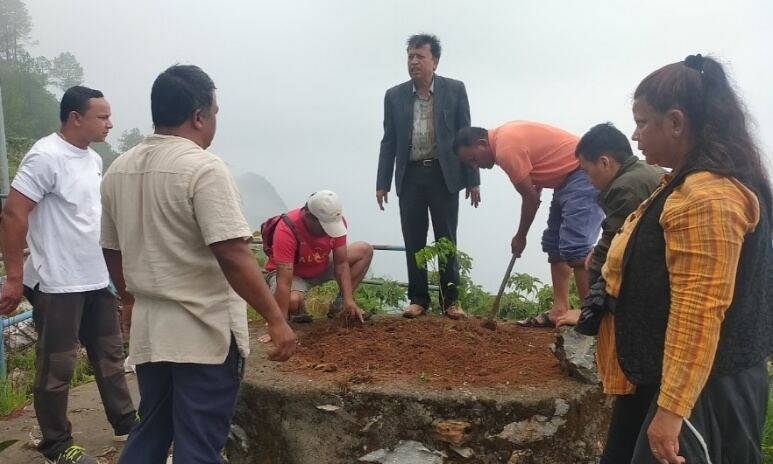
The Mayor of Bandipur Rural Municipality (orange shirt) and community volunteers with Ithaka Team.
Feeding the soil before the trees go in
Bare, eroded ground doesn't hold water or nutrients well, so before any planting, workers cleared invasive shrubs like Eupatorium adenophorum and converted the cleared biomass into biochar using flame curtain kilns. Mixed roughly one part biochar to four parts goat manure sourced from nearby farms, the blend went straight into each planting pit, about a liter of it per tree. That's not a large amount of material per tree, but across 3,420 planting pits it added up to 684 liters of biochar in total, and the improved water retention and root-zone fertility mattered most exactly when it counted: through the driest months, right after a sapling went into the ground.
Solving for water on a ridge with no springs left
Water scarcity on the exposed upper slopes was the project's hardest problem. The fix was fog water harvesting: bamboo-framed nets, anchored with earthbags, positioned to catch moisture drifting through on the wind. What started as two small one-square-meter test nets grew into four large six-square-meter units plus the two originals, feeding water through PVC pipes into two 20,000-liter ponds and six sealed storage tanks. Tanks turned out to work better than ponds, since open water lost far more to evaporation.
During the dry season of November 2024 to February 2025 alone, the system captured about 6,600 liters, averaging 2.1 liters per day for every square meter of net. Combined with mulching to cut down on soil evaporation, that water kept survival rates high through the exact stretch of the year when young saplings are most likely to die.
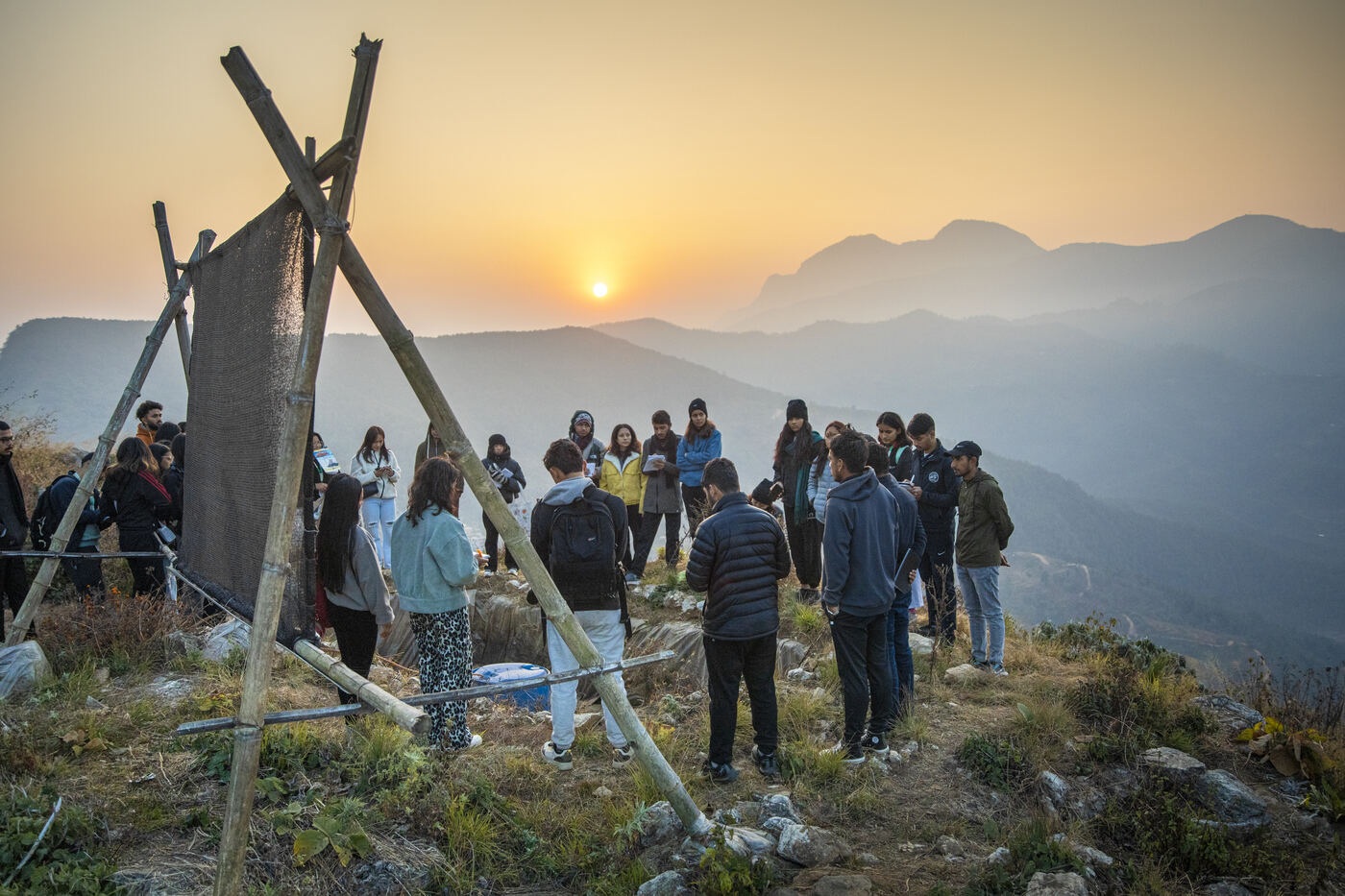
Forestry students from Kathmandu Forestry College (KAFCOL) learning about the reforestation project on-site.
A fire, and a lesson that stuckIn April 2024, a wildfire crossed into the plantation despite the fire lines already in place, damaging several hundred young trees. The response afterward was to widen the fire break to two meters and lean harder on TMCC members patrolling during the dry season. It worked: in 2025, a nearby wildfire was stopped before it reached the plantation at all, credited mostly to how motivated the local community had become about protecting ground they'd helped restore.
What three years of measuring shows
Each block tells a slightly different story. Block one, the oldest, started with 1,005 saplings in 2022 and had grown to 1,150 trees by 2025, 848 of them the original plantings (an 84 percent survival rate) plus 302 that came up naturally on their own. Block two, planted in 2023, held 1,102 trees by 2025: 926 planted, 176 natural. Block three, the youngest, showed the strongest first-year numbers of all, 821 of 858 saplings surviving their first year, a 96 percent rate that reflects three years of trial and error paying off.
Add it all up and the three blocks together hold 3,134 living trees: 2,479 planted saplings and 655 that regenerated on their own, an average planted-tree survival rate of 73 percent. That natural regeneration figure matters as much as the planting numbers. It means the restored ground is recovering its own microhabitats well enough that seeds are finding their way in and taking root without anyone planting them. Above-ground carbon stock in block one's oldest trees alone rose from 9.9 kilograms in year one to 86.3 kilograms by year three, an eightfold increase in two years as growth compounds.
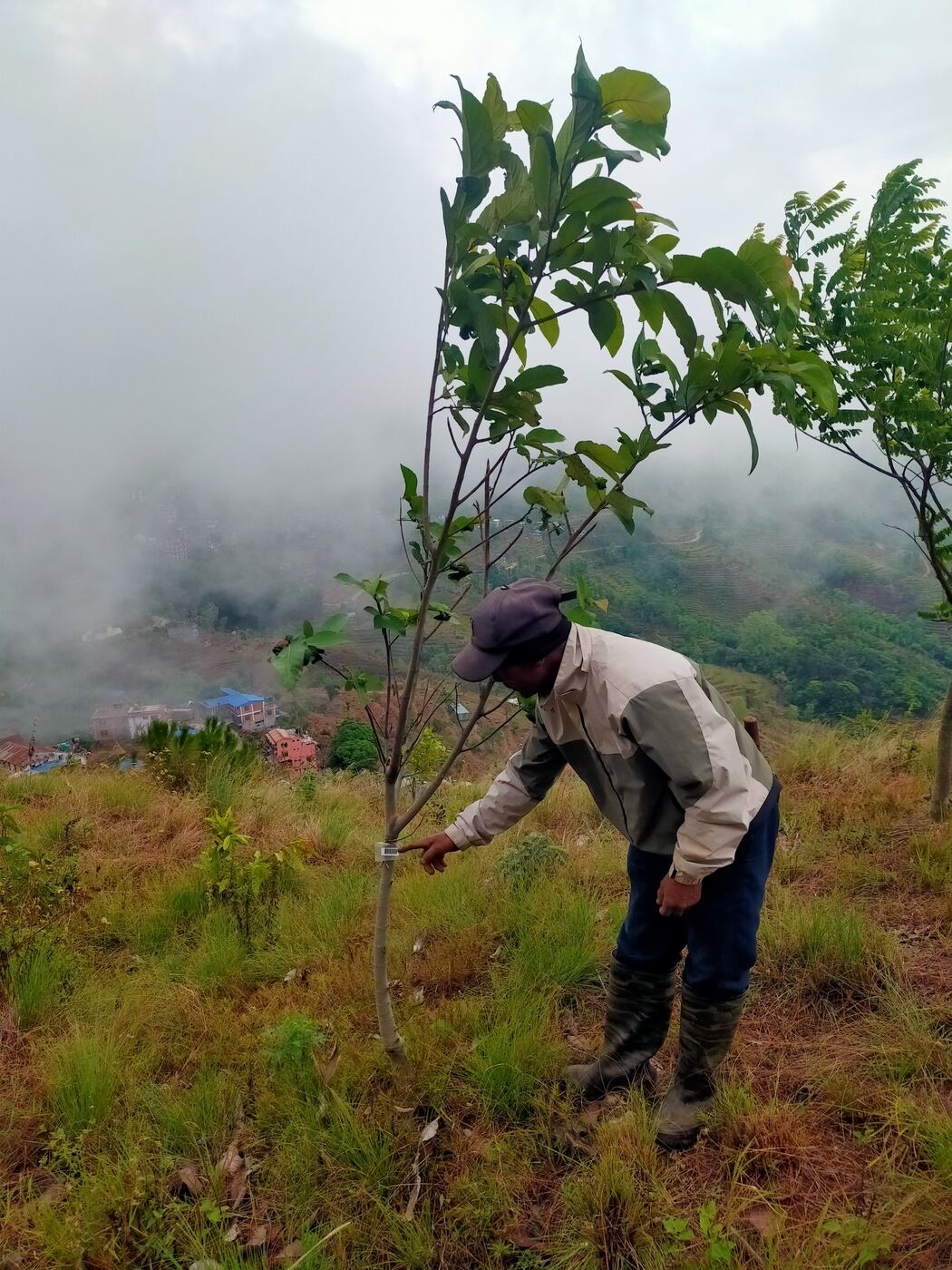
Trees after 3 years. Each planted tree carries its own tag so the team can track its individual growth and survival.
More than a planting project
Forestry students from Tribhuvan University and Kathmandu Forestry College now visit every year to see biochar application, fog nets, and mulching in practice. TMCC and the Purankot Community Forest User Group run awareness rallies on fire prevention and water conservation. The project's reach went further than expected too, with a short documentary on the work appearing on Amazon Prime in December 2024, turning a local restoration effort into something visible well beyond Tanahun district.
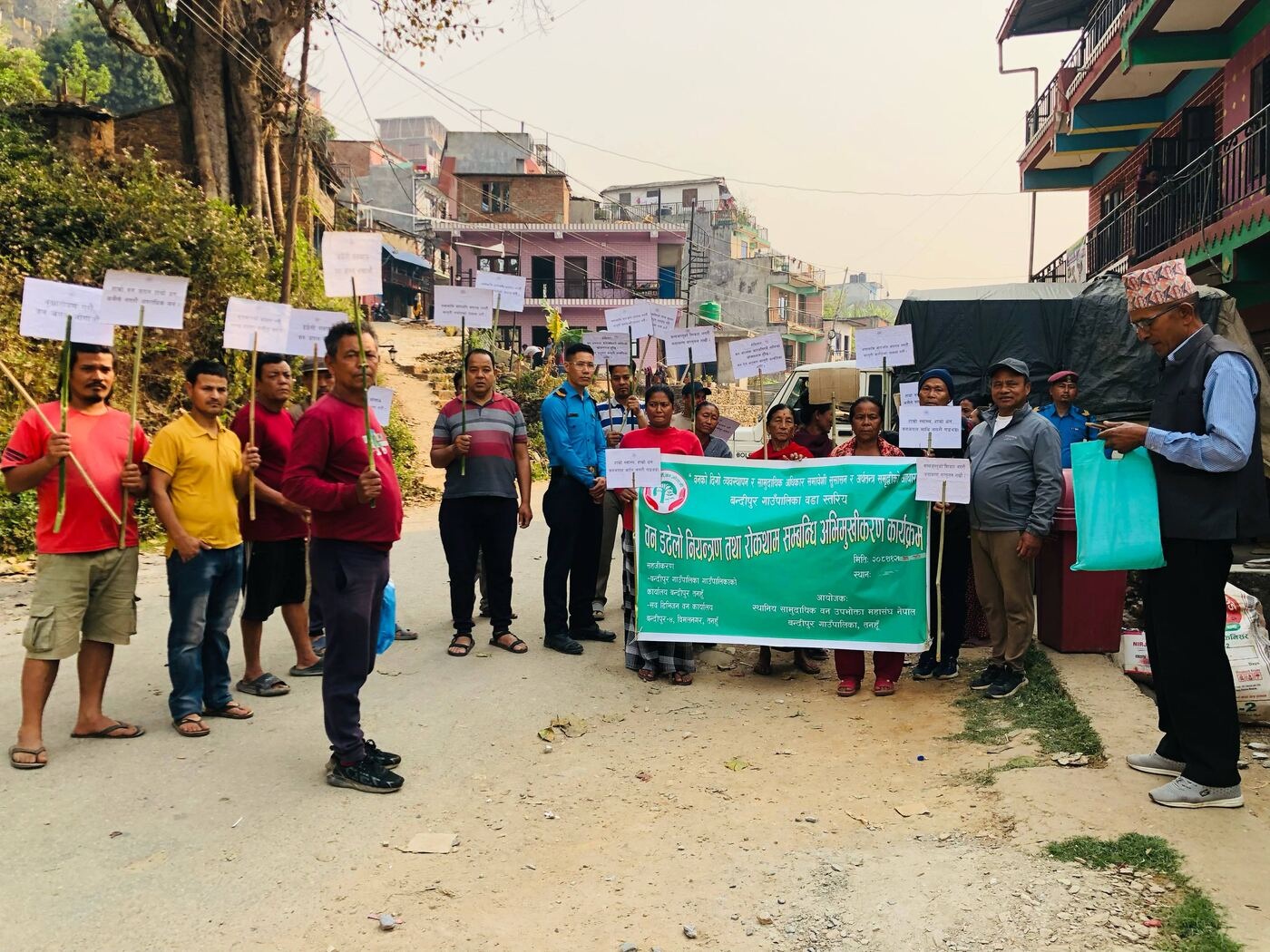
A community awareness event organized by TMCC, part of the project's push to build local stewardship alongside the tree planting itself.
Where it goes from here
Bandipur Hill was always meant to be a 20 to 25 year commitment, and the first three years cover the establishment phase only. The plan now is to expand into adjacent degraded land, working toward 25 hectares total, add structured biodiversity and hydrology monitoring so the project can track whether the springs downhill actually start flowing again, and build out a nature trail and information boards so the site can start generating its own income through education and eco-tourism. If the springs do come back, that will be the clearest sign yet that a hillside written off as unfarmable can still recover.
Implemented by Ithaka Institute for Climate Farming Nepal, in partnership with Bandipur Rural Municipality, the Thani Mai Environment Conservation Committee (TMCC), and Purankot Community Forest User Group. Scientific support from Ithaka Institute, Switzerland. Funded by atmosfair gGmbH, Germany. Project period: May 2022 – May 2025 (Phase 1 of a planned 20–25 year initiative). For more on this project or on supporting the next phase, contact Ithaka Institute for Climate Farming Nepal, Hattiban, Lalitpur.