

Growing a Carbon Farm: Farming for Soil, Climate and Biodiversity
On seven hectares of abandoned rice terraces, Ithaka Institute is running a 30-year trial to find out which mix of coffee, trees, and biochar actually pulls the most carbon out of the air, and pays farmers to do it.
At Ratanpur in Tanahun District, Nepal, a 30-year carbon farming trial is testing nine different farming systems across seven hectares of abandoned rice terraces. Each system uses coffee as the backbone crop, combined with different companion plants, trees, broom grass, bamboo, and biochar. The trial aims to understand which systems can store carbon effectively while also supporting productive and resilient farming for local households.
Seven hectares of old rice terraces sit on the hillside above Ratanpur, halfway between Kathmandu and Pokhara. Most of that land had gone fallow years ago, its owners scattered to the cities or abroad, the fields overtaken by grass and invasive shrubs. What's growing there now is a 30-year experiment: nine different ways of farming carbon, planted side by side, on land that had stopped producing anything at all.
Why coffee, and why nine ways to grow it
Carbon farming is a broad label for any land use built around pulling carbon out of the air and holding it in soil and biomass rather than letting it escape, whether through agroforestry, intercropping, cover crops, or biochar. It sounds straightforward on paper. In practice, nobody has run a real side-by-side comparison of enough systems, long enough, to know which combinations actually deliver on income, resilience, and carbon storage at the same time. That gap is what the Ratanpur trial was built to close, with three questions driving the design: does carbon farming actually suit Nepal's mid-hill climate and soils, can it fit into how people here already farm and organize their communities, and what will it realistically pay a household in yield and sequestered carbon.
Every one of the nine systems being tested carries the same number of coffee trees as its backbone crop, a deliberate choice that lets the team isolate what each companion planting, whether fruit trees, lentils, ginger, perennial grass, or bamboo, actually changes about how the coffee performs. Coffee also travel well as a finding: what works for it in Ratanpur's hills has a shot at meaning something to coffee growers anywhere with a similar climate.
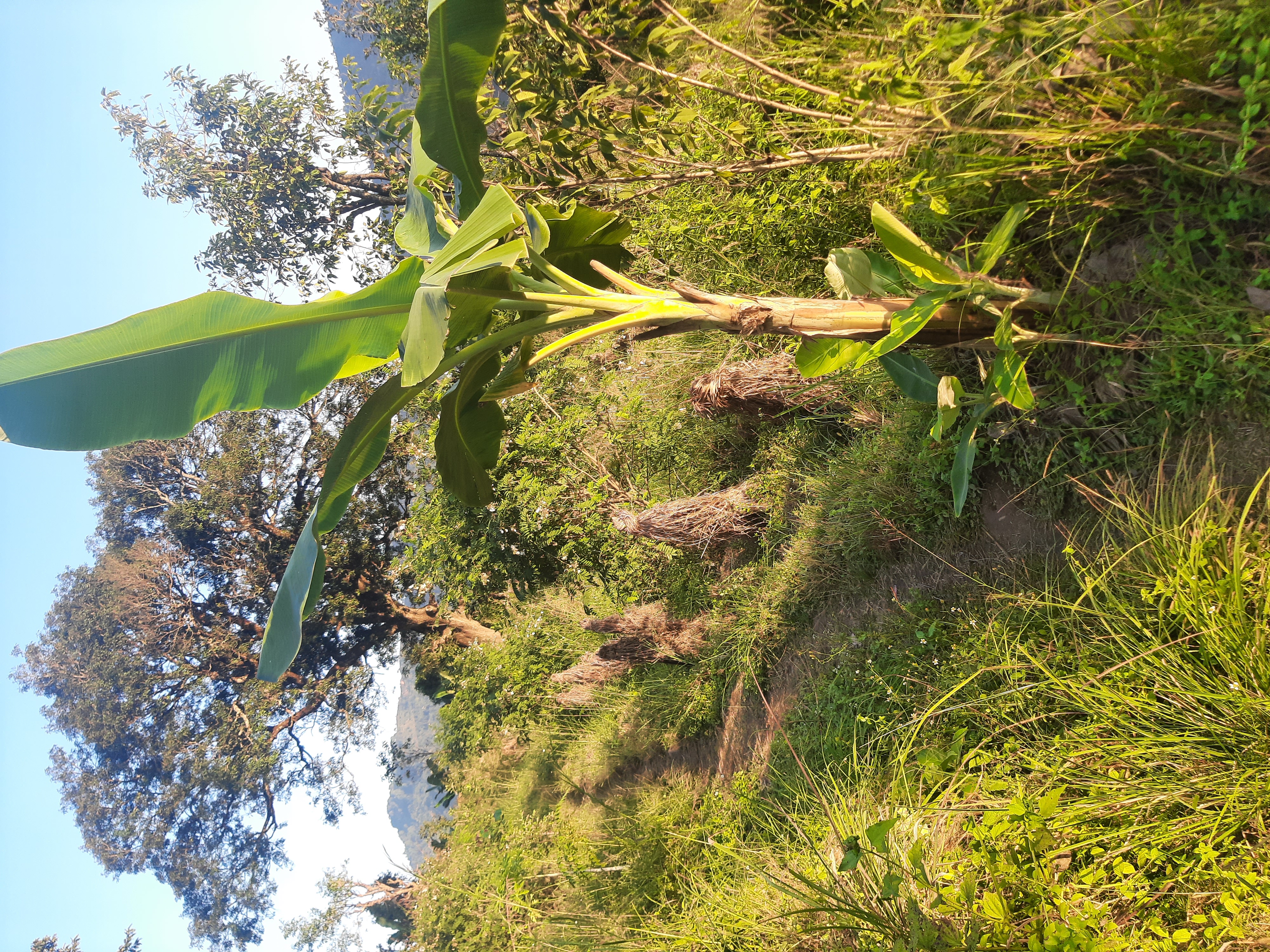
Coffee with commercial fruit plantation, one of the nine companion-planting combinations being tested side by side.
Twenty-seven plots, laid out by hand
Work started in March 2023 with the unglamorous part: walking the boundaries of land pieced together from more than 20 families, none of whom were farming it at the time, and figuring out how to divide it. The terraces were too steep and irregular for anything resembling a neat grid, so the plot boundaries follow the natural contours of the land instead. The result was 27 plots of 2,500 square meters each, split into three blocks of nine plots so that every one of the nine systems appears once in each block, a standard research design that lets the team separate real differences between systems from ordinary variation across the site.
Before any tree went into the ground, the team pulled more than 400 soil samples across all 27 plots and ran organic carbon and bulk density tests on over 80 composite samples in a small lab in the village, no small feat during a dry Nepali March when the ground itself resists a shovel, and when the drying oven had to run on a generator every time the power cut out.
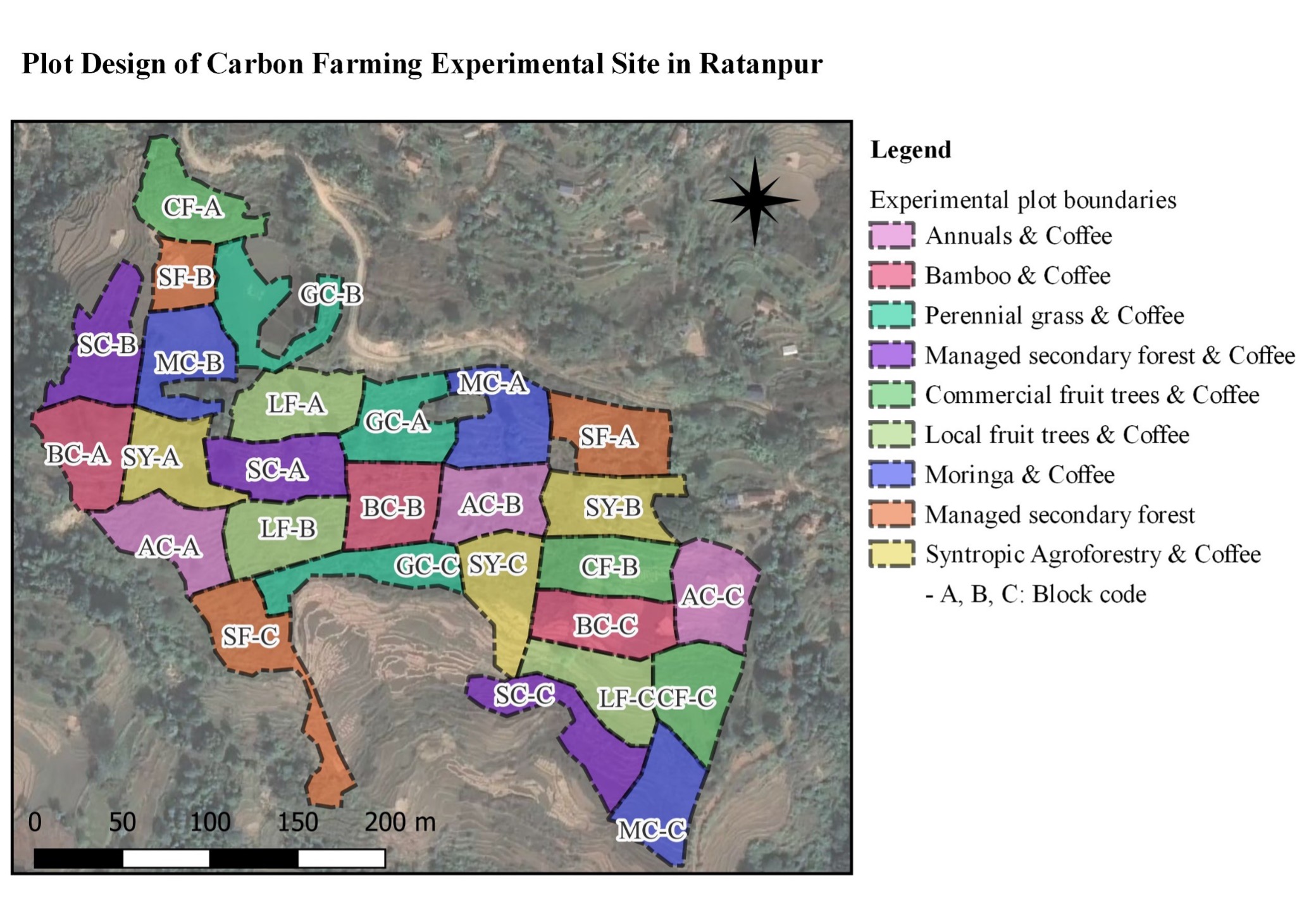
The original plot design map: 27 plots of 2,500 m² each, boundaries following the terrace contours, grouped into three blocks (A, B, C).
Getting trees into steep ground
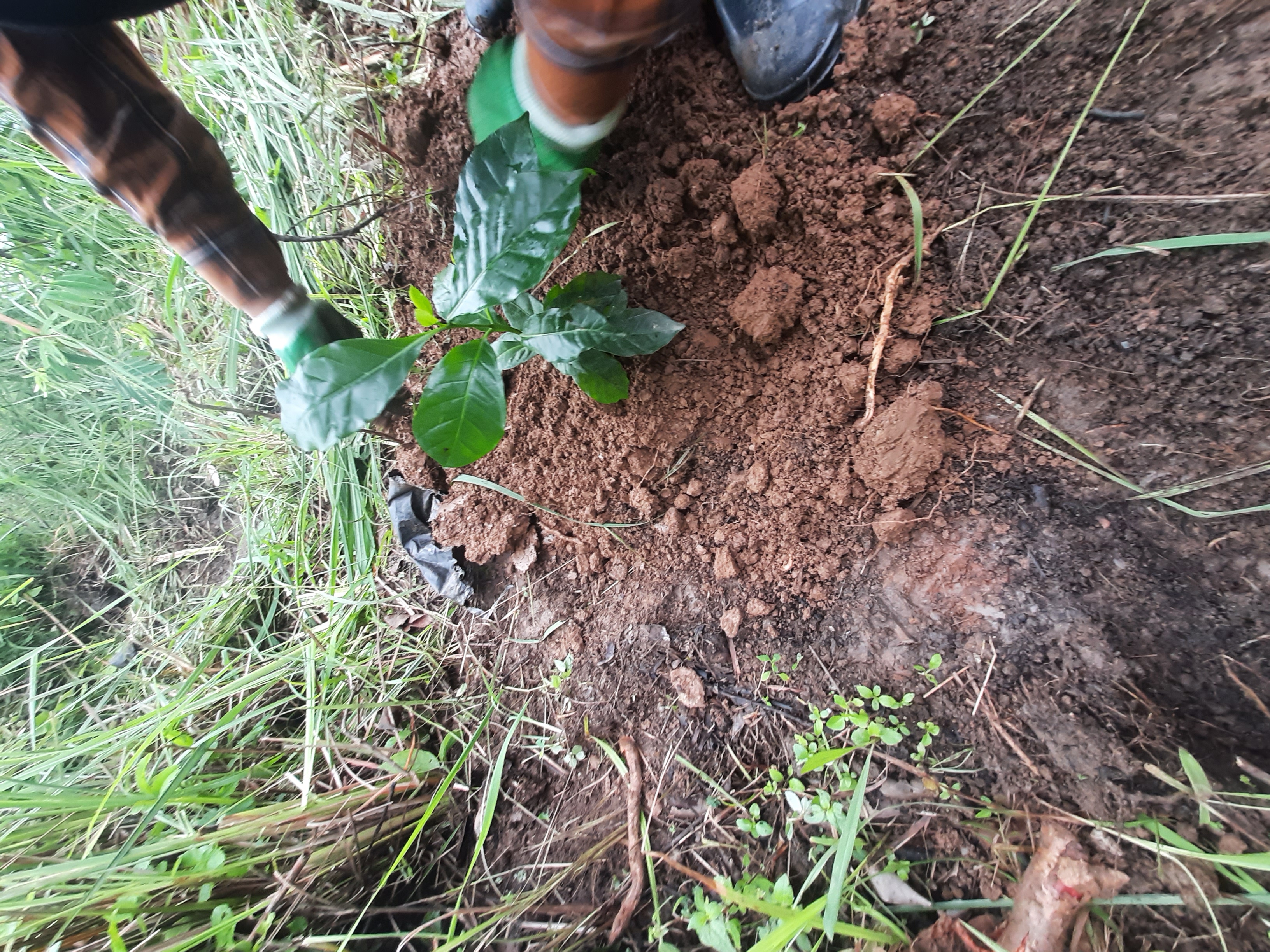
Planting began with the monsoon rains in June 2023. Weeds and invasive shrubs cleared from the terraces went into a Kon-Tiki kiln, about five tons of biomass yielding roughly one ton of biochar, mixed with goat manure and worked into the root zone of every seedling. Coffee went in at two meters within rows and six meters between them, with the wide row gaps given over to whichever companion crop that system called for, fruit trees in some, lentils or broomgrass in others.
None of it moved on wheels. The terraces were too steep for wheelbarrows, let alone anything motorized, so seedlings and fertilizer traveled up the slope in traditional bamboo dokos, carried by a crew that grew to seven people that summer, ranging in age from 22 to 72. A battery-powered auger for drilling planting holes was the closest thing to machinery on site, and its battery life was, for a while, the actual bottleneck on how fast the team could work. Every tree also got tagged with its own barcode as it went into the ground, the start of a tree-by-tree monitoring system the team still uses to track individual survival and growth. By the end of that planting push, 5,950 coffee and fruit trees were in the ground, with broomgrass, lentils, bamboo, and moringa going in through August and September.
The dry season pushed back
By October 2023, the gap in the plan showed up. Fast-growing legume shrubs planted alongside the coffee to provide shade hadn't grown tall enough yet, and a number of the young coffee plants were visibly stressed under direct sun. The workaround was low-tech: small tepee-shaped shelters built from bamboo and cut grass, shading individual seedlings until the permanent shade cover caught up. Fruit trees, lentils, and broomgrass came through the first dry season fine. A portion of the coffee did not, and the team flagged it for replanting the following year.
2024 brought a more deliberate approach. Rather than replant at the original scale, the team put 1,500 coffee seedlings into larger planting holes, reused the bamboo-and-grass shelters from the start, and prioritized getting fewer trees established well over pushing for higher numbers. By October 2024, the difference was visible, the new plantings were noticeably healthier than the previous year's survivors, and by May 2025 some had already outgrown their original shelters.
What the village made of it
Most Ratanpur residents already knew biochar from earlier Ithaka work in the area, so the concept wasn't a hard sell. Coffee was the part that caught people's attention, a genuinely new crop for most of them, and one that carried the possibility of Ratanpur becoming known for something beyond what it had always grown. One farmer told the team that if new coffee-growing methods took root here, it could put the village on the map for other growers looking to improve their own yields. That kind of interest has already started to spread on its own: a farmers' cooperative in a neighboring village has begun planting its own mixed coffee and fruit tree orchards on land that had likewise sat unused.
Growth here is slow to start. Two years in, the visible progress is modest, root systems and soil biology are still establishing, and the real gains in biomass and carbon are still ahead.
What the 30-year trial is trying to learn
Over the next 30 years, the trial will show which combinations of coffee, trees, grasses, bamboo and soil-management practices can store carbon while remaining productive and practical for farmers. The results will help determine whether carbon farming can become a realistic long-term option for Nepal's mid-hill communities.
This is a short version of a much more detailed field account. Read the full story, with more on the plot design, planting logistics, and early results, by Simon Lotz on the Biochar Journal: The Carbon Farming Experiment →