

Smoke Out, Biochar In
RATANPUR, TANAHUN DISTRICT · CLEAN COOKSTOVES & BIOCHAR
In Ratanpur, a cluster of villages in Tanahun district, more than two out of three working-age people have already left for Kathmandu, the Gulf, or further afield. What's left behind is mostly elderly women, running households on firewood they still have to cut, carry, and dry themselves. Almost a third of families here can't afford LPG. That's the gap a small metal cookstove was asked to fill.
The stove is called a TLUD, short for top-lit updraft. Light the wood from the top instead of the bottom, and instead of a slow smoky burn you get a hot, largely smoke-free flame that eats through the fuel in a controlled way. What's left in the cylinder once the flame goes out isn't ash. It's biochar, roughly a fifth of the original wood weight, and it's worth something as a soil amendment or as a first step toward a carbon credit.
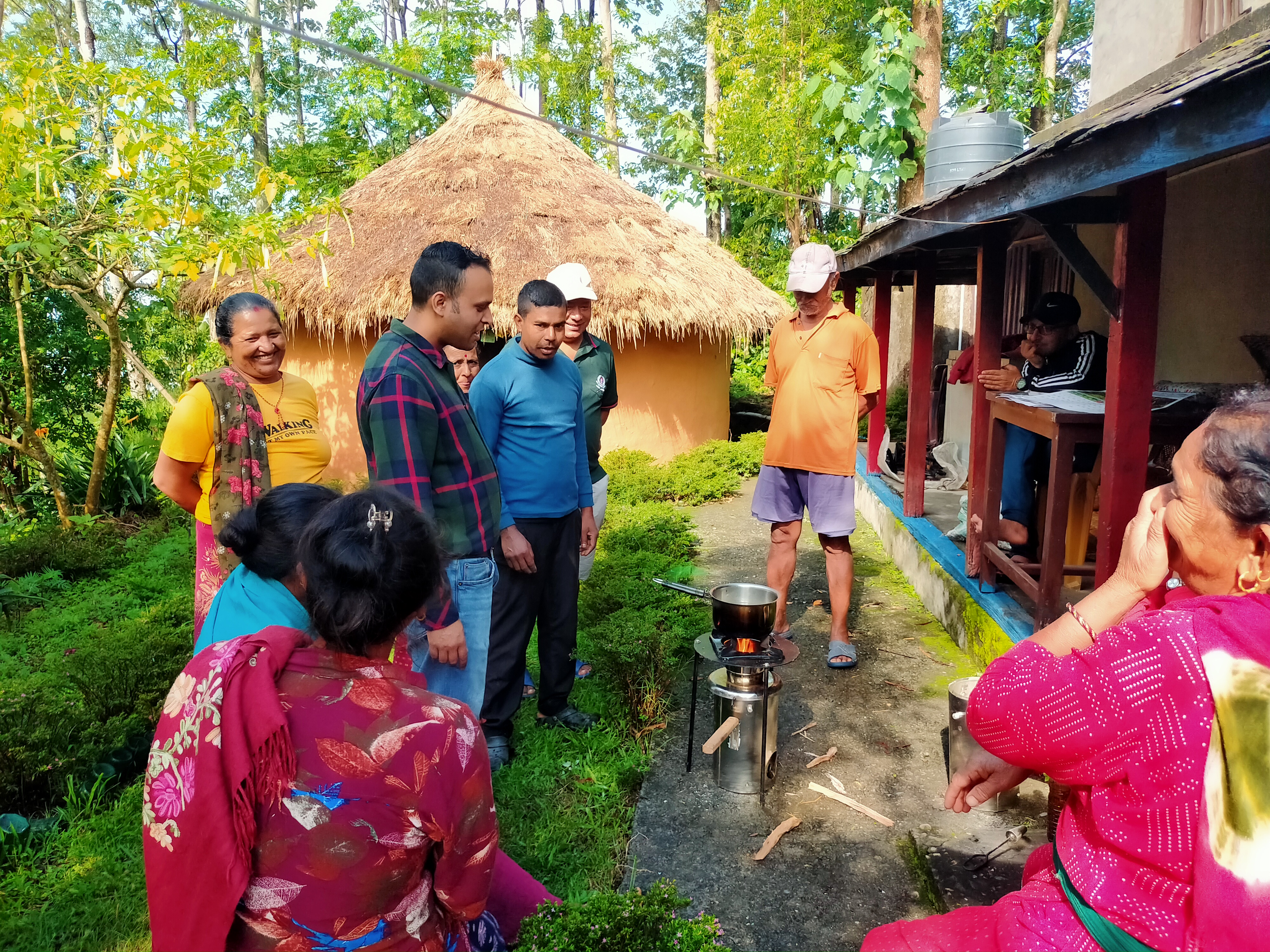
field training on the stove with participating households
Forty stoves, chosen carefully
Before anyone got a stove, the team surveyed 112 households across five villages: Simgaon, Baisghare, Jayapani, Arbaje, and Archale. Sixty-three percent were cooking on firewood as their main fuel, mostly on traditional clay or three-stone stoves, burning through an average of 243 kilograms of wood a month per household. In Jayapani, where almost nobody has LPG, that figure nearly doubled.
From that survey, 40 households were selected: people already leaning hardest on firewood, with little or no LPG access, and a track record of actually showing up for community work. Just over half the participants were women, and most came from Sudra and indigenous communities including Gurung, Magar, Gharti, and Newar households. Each family got two stainless steel cylinders and a shared tripod, all built locally by Mantra Incorporation in Lalitpur, and sat through training on lighting, timing the second cylinder, drying wood, and handling biochar.
HOW THE STOVE ACTUALLY COOKS
A test run timed a full three-dish Nepali meal, a colocasia leaf curry, rice, and dal, cooked across both cylinders. Total time: about 56 minutes, with fuel left over. The second cylinder gets lit a few minutes before the first burns out, so there's no cold gap between batches.
The households setting the pace
Stoves went into use in June 2025, and within the first month the 40 households had already produced 264 kilograms of biochar between them. Then the monsoon arrived. Operations paused from July through September 2025, because wet firewood simply won't run a TLUD stove properly, it needs pieces cut small and dried below 15 percent moisture, and a July moisture check found every household's woodpile sitting between 24 and 42 percent. The pause was used deliberately: families spent it retraining on chopping wood to size and storing it indoors in bamboo baskets instead of under open sheds where damp air soaks straight back in.
Operations restarted on 6 October 2025, and the recovery shows clearly in the numbers. The first post-monsoon round in November came in low, just 59.7 kilograms, as households were still getting their firewood dry. From January 2026 onward, though, collections settled into a steady rhythm of 217 to 227 kilograms per round, and every one of the 26 active households delivered biochar in all three of those post-monsoon rounds. Across the full eighteen months and five collection rounds, the pilot produced 987.47 kilograms of biochar in total, an average of just under 35 kilograms per active household. Production really found its footing in the second half of the project, well after the monsoon setback, and held there for the rest of the pilot.
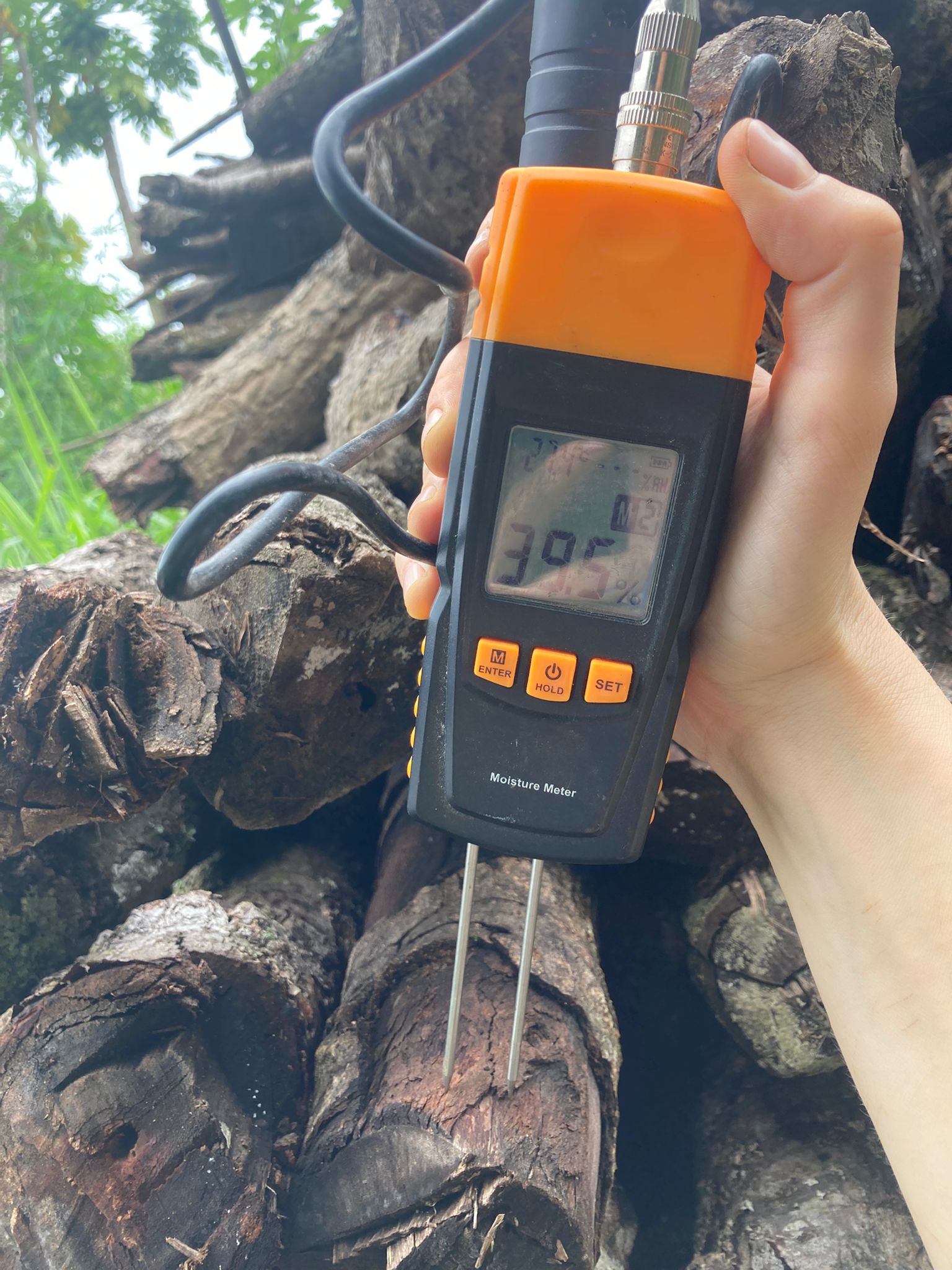
A moisture meter reading nearly 40 percent on a household's woodpile during the 2025 monsoon, well above the 15 percent a TLUD stove needs to run properly.
What the numbers say
The satisfaction data is strong across the board. Every one of the 26 active households reported noticeably less smoke and less eye irritation and coughing since switching to the TLUD. Seventy-seven percent said they were satisfied or very satisfied overall, 77 percent intend to keep using the stove after the project ends, and 92 percent said they'd recommend it to a neighbor. All 26 households also said they wanted more training on using biochar as a fertiliser, a strong signal of appetite to take the work further than the pilot itself asked.
All 26 active households reported much less smoke while cooking. Twenty of them said they'd continue using the stove after the project ends, and 24 said they'd recommend it to a neighbor.
It's worth being honest about where it didn't fully land, too. Of the original 40 households, 14 had effectively dropped out by project close, mostly because chopping wood down to the size the cylinder needs proved more physical effort than they were prepared to keep up, along with a handful who'd shown limited interest from the start. Among the 26 who stayed active, six said sooty pots were enough of a nuisance to discourage heavier use, particularly in households used to the cleaner cookware LPG leaves behind. Both are specific, well-understood reasons rather than a general failure of the technology, and both are feeding directly into how the next round of stoves gets designed and rolled out.
Where the biochar actually goes
Very little of the biochar collected from Ratanpur households sits idle. During the monsoon pause, Ithaka Nepal staff charged the first batches with buffalo urine and applied it to vegetable plots at the institute's demonstration farm, sowing mustard green, radish, and carrot straight after. That same enriched-biochar approach has continued since: biochar gets co-composted with manure, used as a litter additive inside livestock shelters where it helps absorb moisture and odour before being worked back into the manure itself, and mixed with livestock manure and urine into a slow-release fertiliser that has gone into the coffee-based forest gardens at the carbon farm.
Ithaka Nepal has folded it into an older building tradition too, mixing biochar with clay and chopped hay to make a plaster, and using it on the walls of Ithaka Nepal's own kitchen in Ratanpur, the same kind of natural plaster used in the region for generations, now with biochar added for its insulating and moisture-regulating properties. It's a small demonstration of a use for biochar well beyond the collection bag, one the team hopes participating households will pick up on their own kitchens over time.
Conclusions
The pilot leaves two problems worth naming plainly. Chopping wood down to the size a TLUD cylinder needs is real physical labour, and it falls hardest on the people already carrying the most of it, older users and the women who make up the majority of Ratanpur's remaining working-age population. A shared, community-based mechanical chopping station, one machine serving 15 to 20 households, would take that burden off individual families and is the clearest single upgrade for the next phase.
The second problem is more structural: in a place like Ratanpur, where firewood still costs nothing and is easy to gather, the incentive to fully switch stoves is weak, which is part of why most households settled into using the TLUD as a second stove rather than a full replacement. That points to where scale-up should go next, communities where firewood is genuinely scarce or has to be purchased, where the efficiency argument for a TLUD is immediate rather than optional.
Alongside that, there's a real opportunity to connect the biochar itself to carbon credit markets. A pilot of this size produced under a tonne of biochar, but formal certification, through a methodology like the Global Artisan C-Sink standard, could turn what's currently a token payment to households into a genuine income stream, and give the whole model a stronger economic footing as it moves beyond Ratanpur.